

Grip, freedom and the long game.
Vital MTB’s D3A review opens up a useful conversation about foot placement, dependable internals and a pedal built for more than its first ride.


A review worth spending a little time with
There is plenty to enjoy in a positive review. But the most useful part is often the detail: the observation that tells you how a component might fit the way you ride. In Johan Hjord’s D3A review for Vital MTB, published on 24 August 2026, that detail is the relationship between grip and the freedom to adjust your foot.
Johan spent several months riding the Large PEMBREE D3A. His feedback gives us a welcome opportunity to talk about what we value in a flat pedal: support you can settle into, a connection that suits your riding, and construction worth keeping in service. We’re pleased to see those qualities explored through the experience of someone using the pedals on the trail.

Grip matters. So does finding your footing.
Johan notes that “it allows for subtle corrections to your foot placement without having to take the foot completely off the pedal.” That is the balance worth looking at: traction alongside the ability to find your footing.
Instead, think about the moments between the ideal ones. You have dabbed a foot and put it back slightly farther forward than intended. Or your stance feels fine for pedalling but you would like to settle differently for the next descent. Being able to make a deliberate adjustment is part of the appeal of riding flats. It deserves a place in the conversation alongside outright traction.
For us, the useful balance is a secure contact point that still leaves room to find your position. That is different from wanting your foot to move accidentally. A rider chasing the most tenacious hold in very rough conditions may put a different emphasis on that trade-off. The aim is to find the connection that feels right for your riding.
Your shoes are part of this too. Rubber, tread and sole shape influence the connection. If you need to reset, do it on a manageable section, take pressure off the pedal and lift your foot enough to clear the pins. Repositioning is a deliberate action, not a reason to force your sole sideways while heavily loaded.
Support is more than the number of pins
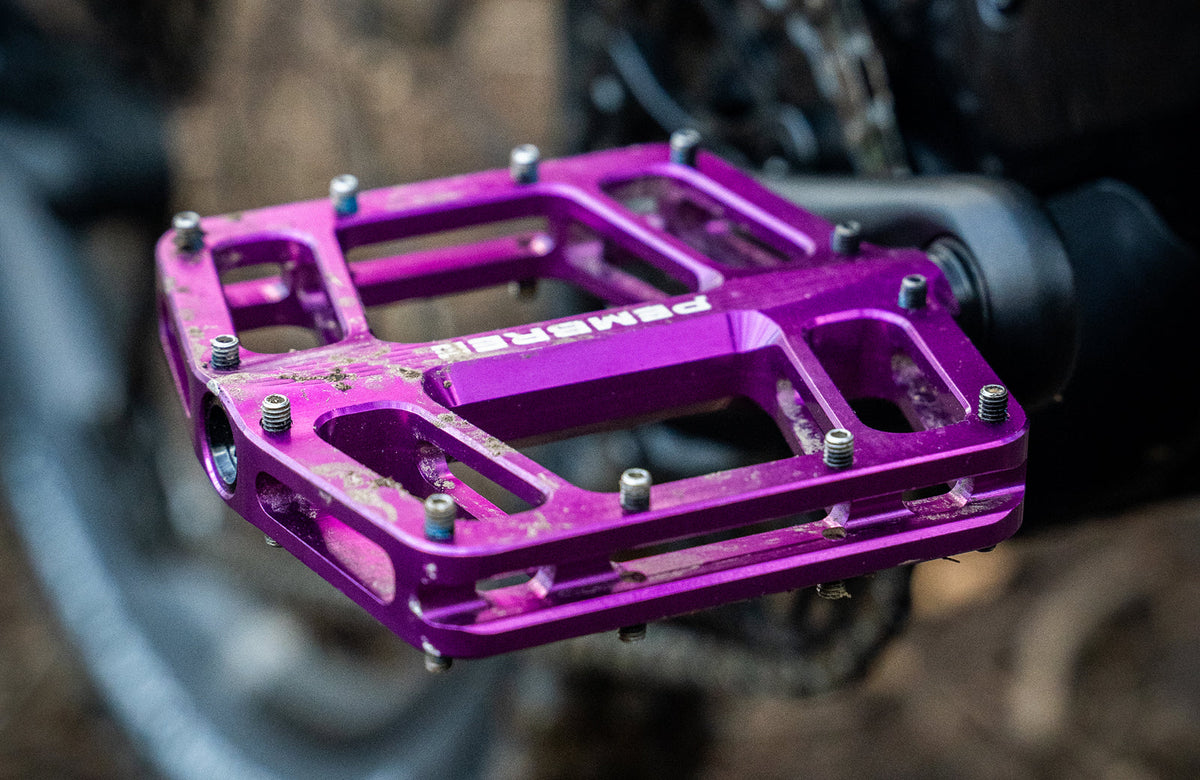
The D3A combines a CNC-machined, double-concave aluminium body with 12 thread-locked M4 traction pins on each side. The platform gives the shoe somewhere to settle; the pins provide contact around it. Looking at either feature in isolation misses how the whole pedal meets your foot.
There are two platform sizes: Small at 108 × 100 mm and Large at 116 × 110 mm. Rather than treating a larger pedal as an automatic upgrade, start with your shoe and the support you prefer. The D3A guide explains the sizing options. A comfortable, well-matched platform makes more sense than choosing a number simply because it is bigger.
The movement you want. And the movement you don’t.
Foot-position adjustment is useful movement. Unwanted play inside a pedal is quite another matter. That is why this line from Johan’s time on the D3A means a great deal to us:
“nor has the pedal developed any kind of slop in the spindle”
In everyday language, that means he had not detected looseness in the pedal’s spindle assembly during his test. It is reassuring feedback after months of use. A pedal can look good when it is new; keeping a solid, consistent feel as the rides add up is what we want from its internals. That was Johan’s experience over the test period, with ongoing care and inspection still part of ownership.
A strong spindle is only part of the story
At the centre of the D3A is a high-strength forged chromoly steel spindle. It is the axle connecting the pedal to the crank. Around it, the body needs to rotate smoothly while being properly supported. Spindle material, bearing arrangement and protection from contamination therefore deserve to be considered together.
Vital describes an inboard bushing and two outboard bearings. Inboard means the crank side; outboard is the outer end of the pedal. The bushing supports the body nearer the crank, with the two bearings supporting it farther out. The bushing layout also avoids a raised inboard bearing housing on the platform.

Forged chromoly spindle
The structural connection between pedal and crank.
Inboard bushing
Support at the crank-side end of the pedal body.
Two outboard bearings
Rotating support towards the outer end.
Seal system
Protection intended to limit dirt and water reaching the internals.
This is the less visible side of pedal design, but it matters every time you put weight through the bike. Smooth rotation, stable support and protection from contamination are connected jobs. A strong spindle gives the assembly its backbone; the surrounding parts help it keep doing that job ride after ride.
Built with Tuesday in mind
‘seals designed to deal with challenging weather conditions – or as it’s called in the UK, “Tuesday”’

We enjoyed that one. Wet riding is hardly an unusual edge case for a British mountain-bike component. The seals are there to help keep contamination away from the working parts, rather than leaving the bearing arrangement to face the elements unprotected.
Sealed does not mean maintenance-free. After muddy rides, use a gentle rinse, avoid aiming a pressure washer at the spindle seals and check for roughness or play. If something changes, have it inspected. Looking after the internals is part of keeping the pedal feeling right, not a contradiction of designing it for bad weather.
Good pedals should have a future
Durability matters most when it is backed by a practical route to repair. The D3A spindle replacement set includes left and right assemblies with associated bearings, washers, O-rings, spacers and retaining nuts. Small and Large versions are available to match the pedal. Worn internals need not automatically mean replacing the complete pair.
The same thinking applies outside the spindle assembly. Dual-access pins can be removed from above or below if one tool interface is damaged, and the recessed end cap reduces its exposure to rock strikes. These are modest-looking details, but service access is much easier to appreciate when a component actually needs attention.
Use the correct replacement parts and service procedure, or ask a qualified mechanic to carry out the work. Repairability means having a sensible way forward when wear occurs. It does not mean ignoring damage or assuming a new small part will put every hard-hit pedal right.
A verdict we’re pleased to share
Johan also places the D3A towards the premium end of the market. That is a fair consideration, just as ultimate grip is. Our view is that fit, feel, construction and the ability to keep a pedal working all belong in a buying decision. A review is most helpful when it leaves room for those priorities to differ.
“Those looking for a well-made flat pedal that feels good out on the trail and is robust enough to deal with some proper abuse will be well served by the D3A.”
We’re pleased with that conclusion, and with the detail that led to it. Thank you to Johan and Vital MTB for spending the time on the pedals. Read the complete review for his full assessment, then decide whether that balance of grip, freedom and durability sounds like the one you want beneath your feet.
Small or Large? See the difference.
Move the dividing line to compare the two Silver D3A platforms from the same front-facing view.
Small measures 108 × 100 mm; Large measures 116 × 110 mm. Choose the support that suits your shoe and the way you ride.

 ‹ ›
‹ ›
Drag the divider, or use the arrow keys when the slider is focused.
Six colours. One D3A.
Pick your finish. Each link opens that colour in Large; you can select Small on the product page.


Le cintre GCS de PEMBREE obtient la note de 9/10 sur off.road.cc